A Goal-based Ranking for FIFA World Cup 2026
When Spain lifted the World Cup a total of 308 goals were scored in 104 matches by the 48 teams that participated, for an average of 2.96 goals per match. What if a goal-based scoring system were to have been adopted: Would Spain have ranked at the top? Would England have been #3?
The group stage which ended on 27 June 2026 saw 48 teams play 72 matches, in twelve groups of four teams each. Two teams qualified from each group for the knockout stage. Another 8 teams were added from the 12 third-placed teams using a complex non-intuitive protocol, too difficult to describe here:
(https://en.wikipedia.org/wiki/2026_FIFA_World_Cup).
We could have avoided all this if a simple head-to-head tournament matrix procedure had been adopted (https://link.springer.com/article/10.1007/BF02289722) based on the work of an Indian mathematician C Ramanujacharyulu (henceforth Ram’s tournament metaphor). Ideally Ram’s method needs a complete tournament, with each team having played the other at least once, for a total of 1,128 matches! This could have taken a whole half-year or thereabouts! Actually, in 2026, the 48 teams played only 104 matches, and a total of 308 goals were scored. With this knowledge, can we construct the tournament matrices based on goals? Note that in this approach, there is no need to resort to penalty shoot-outs. There isn’t even a need to go to extra time (a.e.t.) as is done in the knockout stage!
We will not go into the exhaustive details of how Ram’s method operates as they are available in the public domain (A Goal-based Protocol for FIFA World Cup 2026 at ResearchGate and Academia.edu):
https://www.academia.edu/169371124/A_Goal_based_Protocol_for_FIFA_World_Cup_2026
Table 1 gives the rankings based on Ram’s PWD weighted (Wt) score after 11 iterations. Ram gives Spain a clear lead over Argentina. And Columbia (0.61) is actually ahead of England (0.51). It topped Group K ahead of Portugal and after a goalless draw with Switzerland in the Group of 16 was cruelly eliminated in a penalty shootout.
This very simple algorithm, which can be easily set up in an Excel sheet, is more rational and more intuitive than the 3 points for a win, 1 point for a draw, etc. procedure that FIFA now uses. There is no need for extra time, and no need for penalty shootouts.
Dr Gangan Prathap is an independent researcher associated with Quasity Consulting (www.quasity.com). He was earlier at the National Institute for Science Communication and Information Resources (NISCAIR), New Delhi and later with the National Institute for Interdisciplinary Science and Technology (NIIST), Thiruvananthapuram. Address: 56 Pebble Gardens, Njandoorkonam, Chempazhanthy PO, Thiruvananthapuram-695587; Email: gangan_prathap@hotmail.com
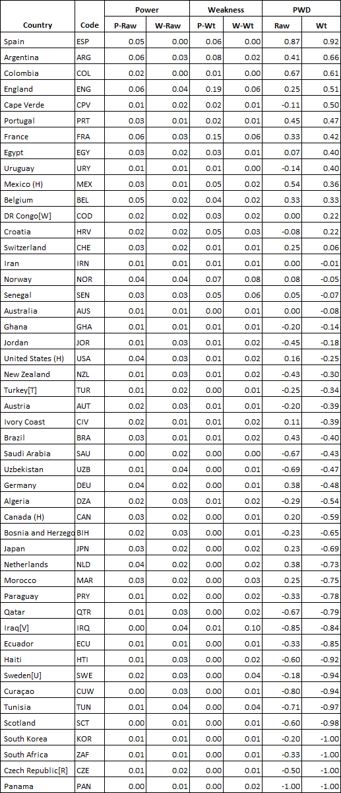
Table 1: The rankings based on Ram’s PWD score after 11 iterations. Spain ranks head and shoulders ahead of Argentina. This is seen in the arrangement of teams in Fig. 1.
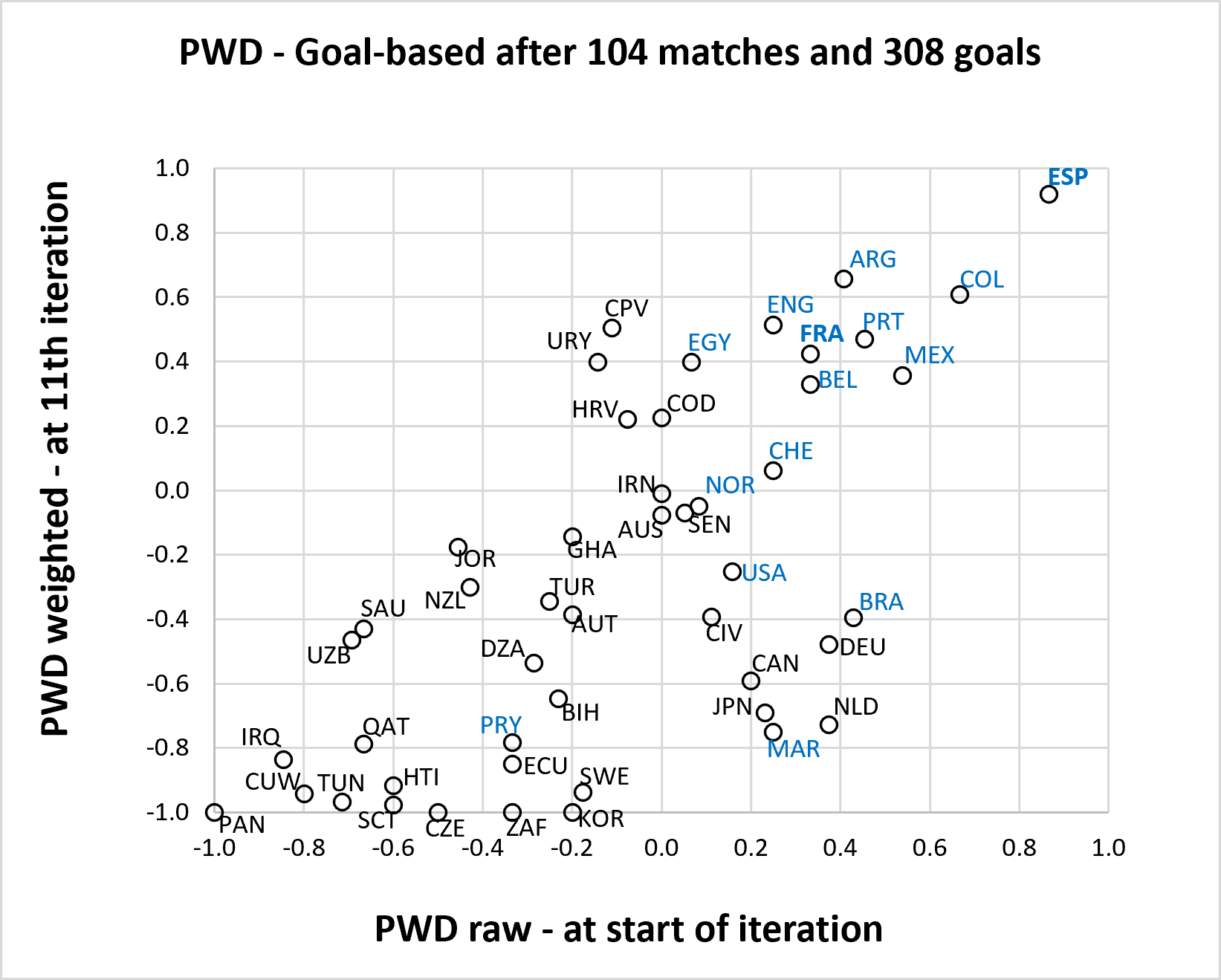
Fig. 1. The rankings based on Ram’s PWD score after 11 iterations. In the arrangement of teams seen in this two-dimensional dispersion, the farther away from the origin, the better (or worse) the team is. Ram gives Spain a clear lead over Argentina. And Columbia is actually just ahead of England. It topped Group K ahead of Portugal and after a goalless draw with Switzerland in the Group of 16 was cruelly eliminated in a penalty shootout.